18 Brilliant Mirror Wall Decor Ideas That Make Small Spaces Feel Huge
Small spaces have a quiet frustration about them. You rearrange the furniture, add a lamp, paint the walls a lighter shade — and yet the room still feels tight. Here’s what actually works: mirrors. A well-placed mirror on your wall does something no paint color or furniture piece can replicate. It catches light, bounces it back into the room, and creates the visual impression of space that simply wasn’t there before. The best part? You don’t need a designer budget or a renovation crew. Whether you’re working with a tiny apartment bedroom, a narrow hallway, or a cramped living room, the right mirror placement can genuinely change how the room feels every single day. These 18 ideas are practical, affordable, and easy to pull off — even if you’ve never hung a picture frame in your life.
1. The Classic Leaner — No Holes, No Hassle
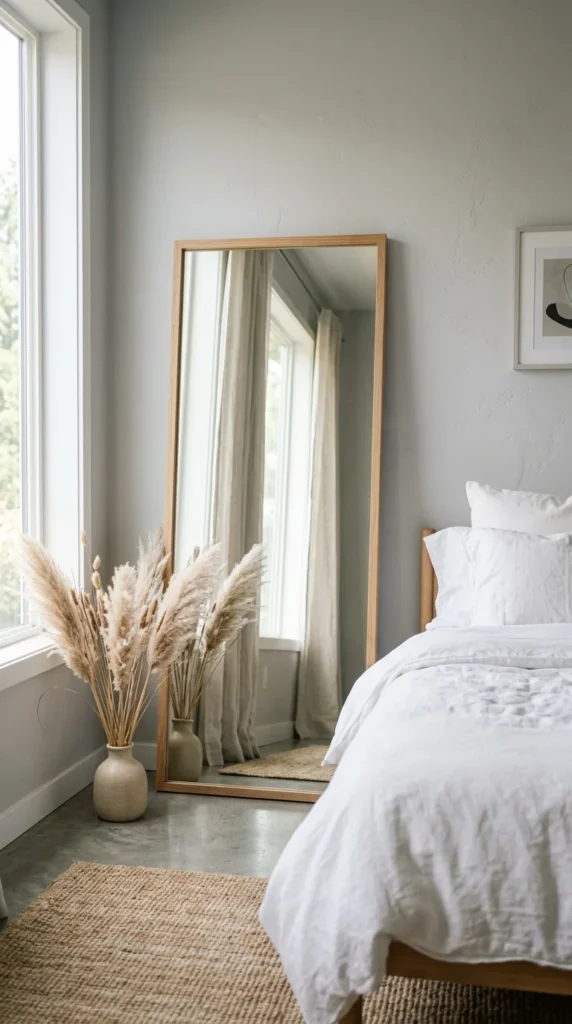
A leaner mirror is one of the easiest ways to add serious visual impact without touching a single wall.
You simply prop a large mirror against the wall and let it do the work. No drilling. No anchors. No commitment.
Choose a mirror that’s at least 60 inches tall. Taller mirrors reflect more of the room and make ceilings feel higher.
Lean it in a corner, beside a dresser, or behind a sofa. Anywhere it catches natural light is a win.
Budget tip: IKEA’s NISSEDAL and HOVET mirrors are both under $100 and look genuinely expensive once styled.
Add a small plant or a stack of books at its base to make it feel intentional rather than forgotten.
This works especially well in bedrooms and living rooms where floor space allows. It also works in entryways — leaning a mirror near the front door instantly makes a narrow entry feel twice as wide.
No tools required. Move it whenever you want. That flexibility alone makes it worth trying first.
2. Sunburst Mirror as a Statement Piece
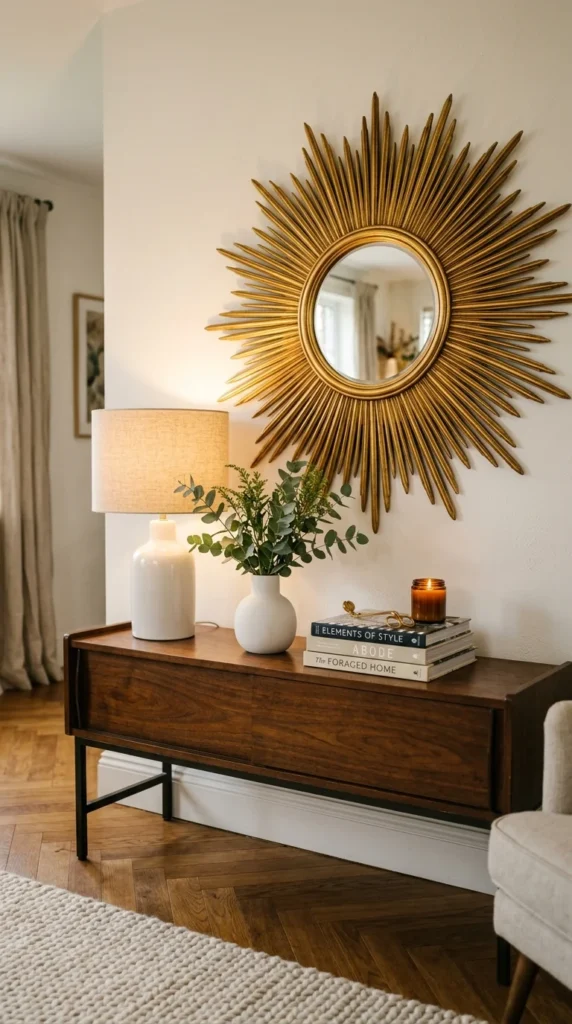
A sunburst mirror is the one piece that looks expensive even when it isn’t.
The radiating spokes create movement on the wall. They draw the eye upward and outward, which tricks the brain into reading the space as larger.
Hang it at eye level or slightly above — roughly 57 to 60 inches from the floor to the center of the mirror.
These mirrors work over console tables, fireplaces, and sofas. They also work alone on an otherwise bare wall — no styling required.
Budget tip: Check TJ Maxx, HomeGoods, and Amazon for sunburst mirrors under $50. The gold and brass finishes photograph beautifully and hold up well over time.
For a DIY version, buy a simple round mirror and hot-glue wooden dowels, painted gold, around the edge. It sounds crafty but the result is genuinely striking.
One sunburst mirror can anchor an entire room’s aesthetic. It’s the kind of piece guests notice immediately — and always ask about.
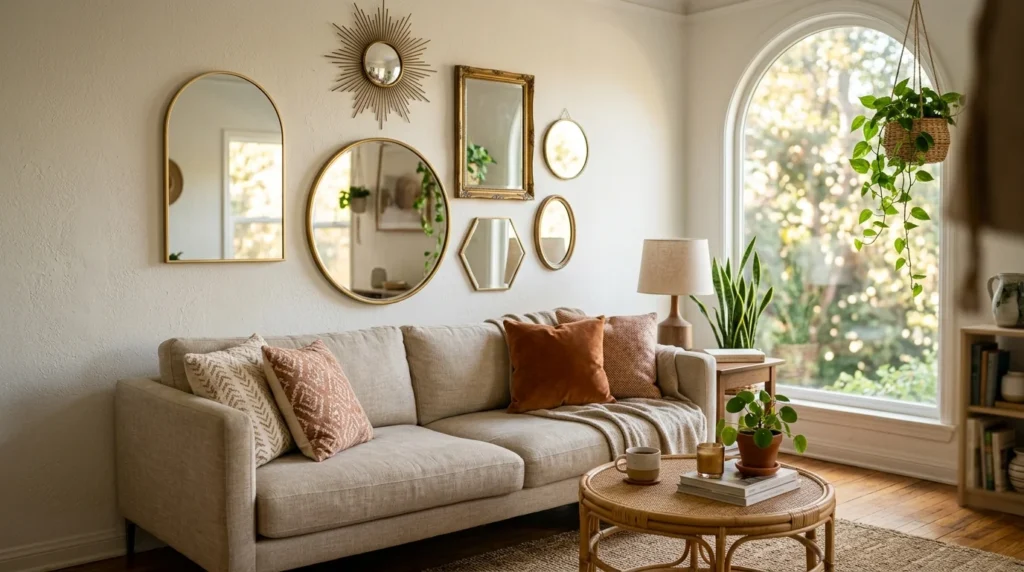
3. Gallery Wall of Mixed Mirrors
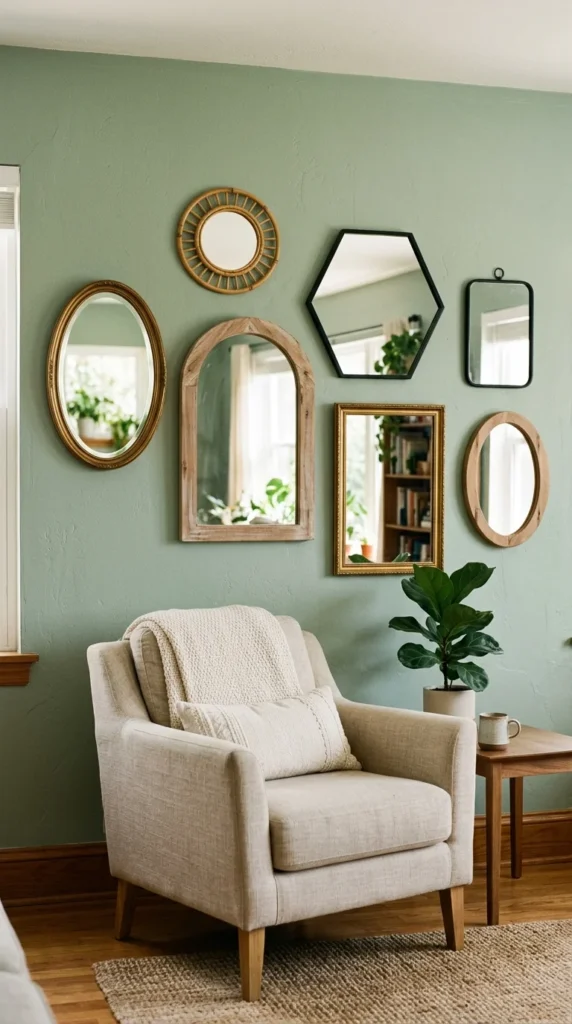
A gallery wall doesn’t have to be made of art. A collection of different mirrors creates something more interesting — and more functional.
Mix shapes: round, oval, arched, hexagonal, rectangular. Mix frame finishes: brass, black, natural wood, white.
The key is keeping the spacing consistent — about 2 to 3 inches between each mirror — while letting the shapes vary freely.
Before hanging anything, lay the arrangement out on the floor. Photograph it. Then transfer it to the wall one piece at a time.
Budget tip: Thrift stores are goldmines for small mirrors. A $3 thrift mirror + a $4 can of spray paint = a perfectly curated gallery piece.
Aim for at least five mirrors in the arrangement. Fewer than that starts to look sparse. More feels intentional and collected.
This approach works on any wall size. In a small bedroom or hallway, even a tight cluster of three to five mirrors reads as a proper gallery.
The varied reflections create layers of depth that no single large mirror can replicate.
4. Floor-to-Ceiling Mirror Panel
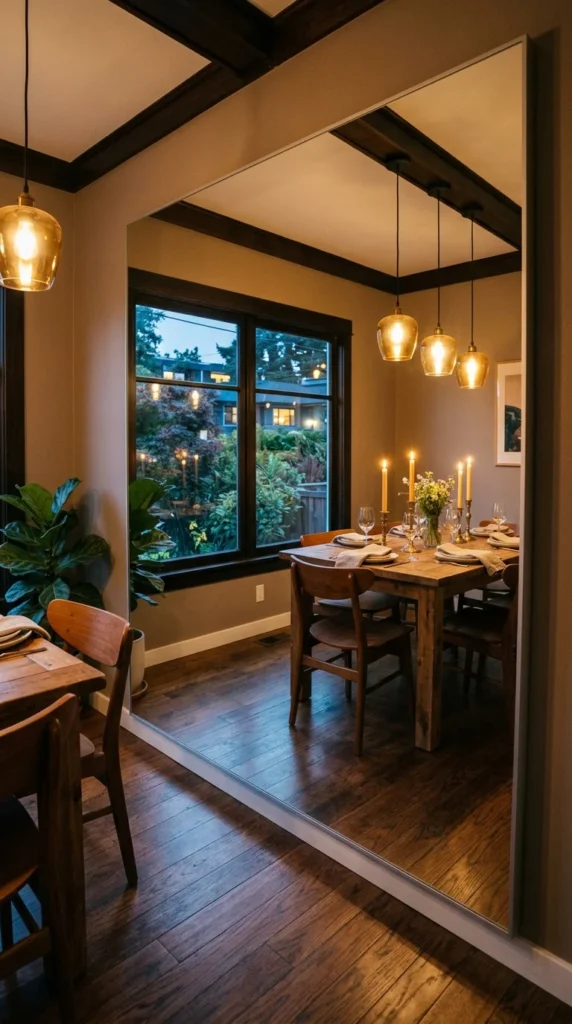
This is the single most dramatic thing you can do to a small room.
A floor-to-ceiling mirror panel on one full wall literally doubles the perceived size of the space. The reflection creates what feels like an entirely separate room behind the glass.
This works best on the wall opposite a window so it reflects natural light all day.
You don’t need a custom installation. Large mirror tiles — available at home improvement stores — can be arranged side by side to cover a full wall. Use mirror adhesive for a seamless finish.
Budget tip: Mirror tiles from Home Depot or Lowe’s run about $8 to $15 per square foot. A full wall in a small room can cost under $200.
Alternatively, look for a large bifold mirrored closet door panel — they’re often sold secondhand for almost nothing.
This technique is standard in dance studios and hotel lobbies for exactly this reason. It works in homes just as well.
The visual effect is immediate and dramatic. Guests will genuinely not be sure where the wall ends.
5. Arched Mirror for a Soft, Architectural Feel
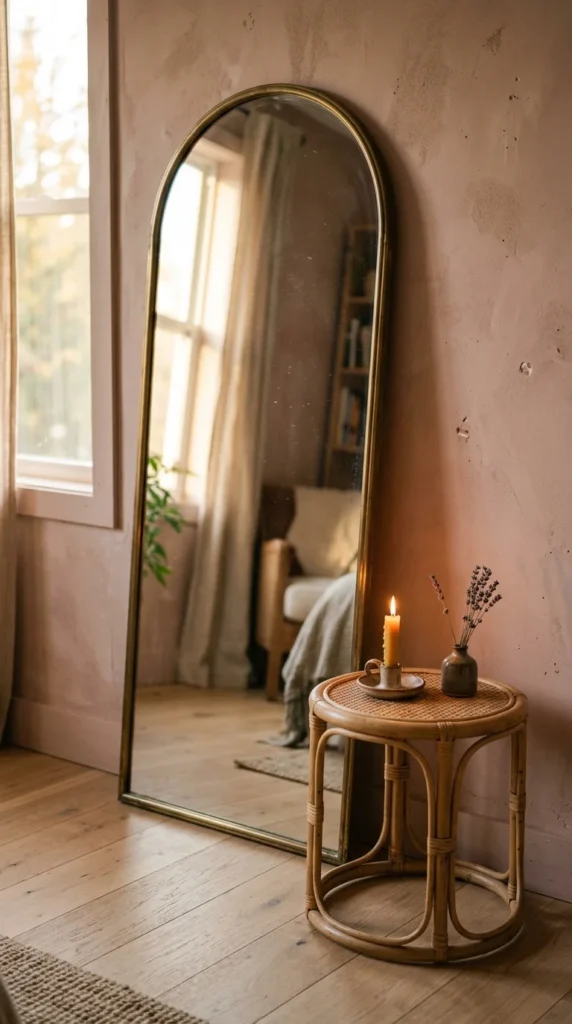
Arched mirrors are having a long, well-deserved moment — and for good reason.
The curved top mimics the shape of a doorway or window. This architectural quality makes any wall feel more structured and intentional.
In small spaces, an arched mirror adds height without weight. It draws the eye up toward the ceiling and makes walls feel taller.
Lean one in a bedroom corner, hang one in a narrow hallway, or place it beside a window to create the illusion of a second window.
Sizes range from small desktop arches to full-length floor mirrors. For maximum spatial effect, go as tall as your ceiling allows.
Budget tip: Arched mirrors have become widely available. Amazon, IKEA, and World Market all carry full-length arched mirrors under $100. Check Facebook Marketplace too — these turn up secondhand constantly.
Pair with warm lighting nearby to soften the reflection and make the room feel cozy rather than stark.
The shape alone adds elegance. It’s one of those pieces that requires almost no styling around it.
6. Mirror Above the Headboard
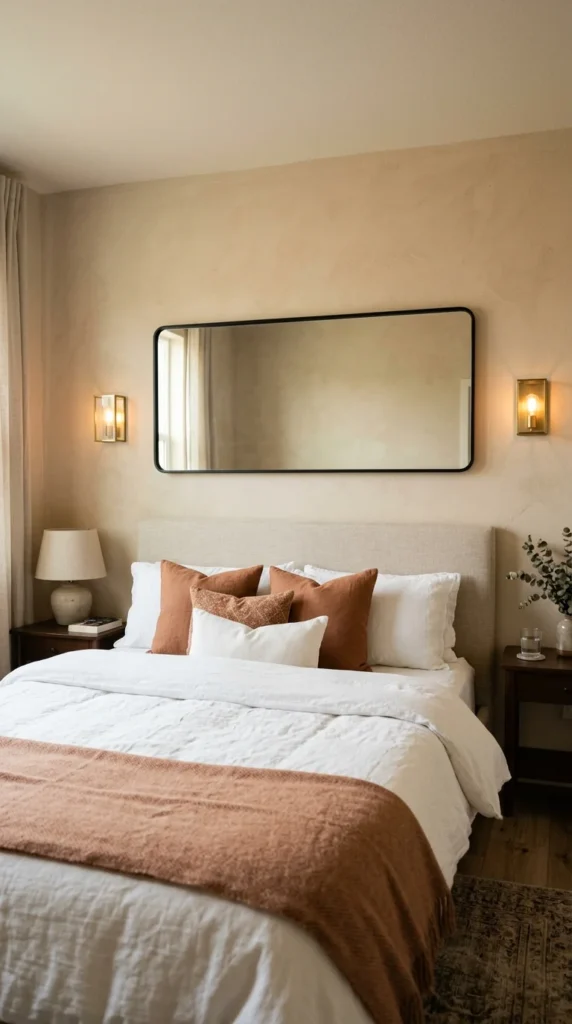
Most people treat the wall above the headboard as an afterthought. A large mirror changes that entirely.
Mounting a mirror above the headboard reflects the ceiling and the light sources in the room. This makes the entire bedroom feel more open — especially in rooms with low ceilings.
Choose a mirror that’s roughly the width of the headboard, or slightly narrower. This keeps the proportions balanced.
Hang it 6 to 8 inches above the top of the headboard. That small gap keeps it from looking like part of the furniture and gives it room to breathe.
Rectangular mirrors work best here. A horizontal format echoes the shape of the bed and keeps the composition grounded.
Budget tip: A frameless rectangular mirror from IKEA mounted with mirror clips costs under $30 and looks intentional and modern.
Add a pair of small sconces on either side of the mirror to turn the headboard wall into a proper focal point.
This is one of the most underused mirror placements in bedroom design. Once you try it, the room will feel noticeably larger every morning.
7. Mirrored Closet Doors That Work Double Duty
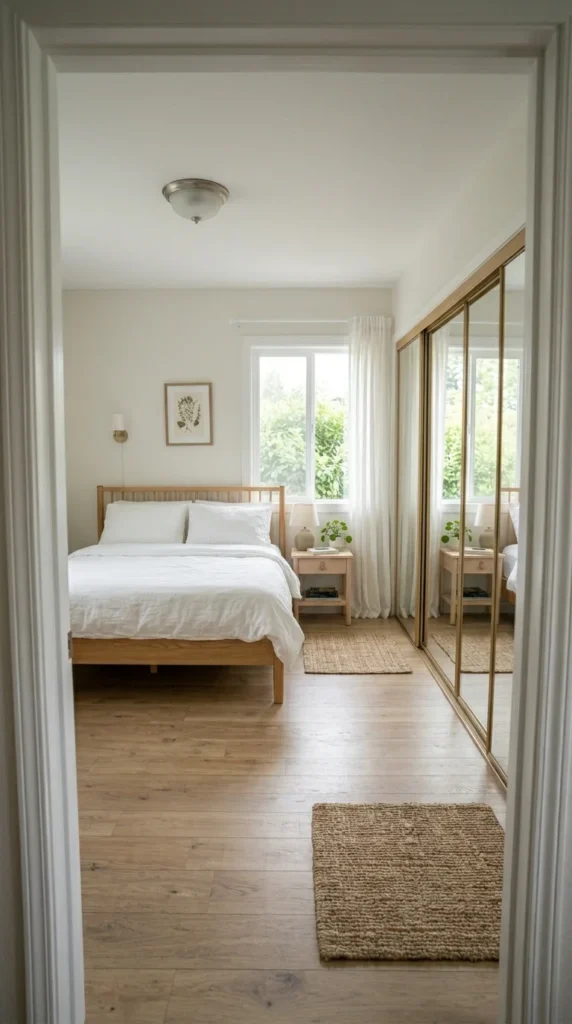
Mirrored closet doors are one of the most practical mirror investments you can make.
They serve two purposes at once: they hide your storage and they visually expand the room. That’s a rare combination in a small space.
Full-length reflections from floor to ceiling are the most effective for making a room feel larger. Unlike a single mirror panel, closet doors span the entire wall width — which multiplies the effect.
If you already have sliding closet doors, mirrored replacements are a straightforward swap. Standard sizes are available at most home improvement stores.
Budget tip: Stock mirrored sliding doors from Home Depot start around $80 to $120 per panel. That’s a significant visual upgrade for a relatively modest investment.
For renters, temporary options exist — mirrored peel-and-stick films can be applied to existing doors and removed cleanly.
Position a lamp or window light source on the opposite wall to maximize what the mirrors reflect.
This approach is common in master bedrooms for a reason. The room simply reads bigger — every single day, with zero additional effort.
8. Convex Mirror for Retro Depth
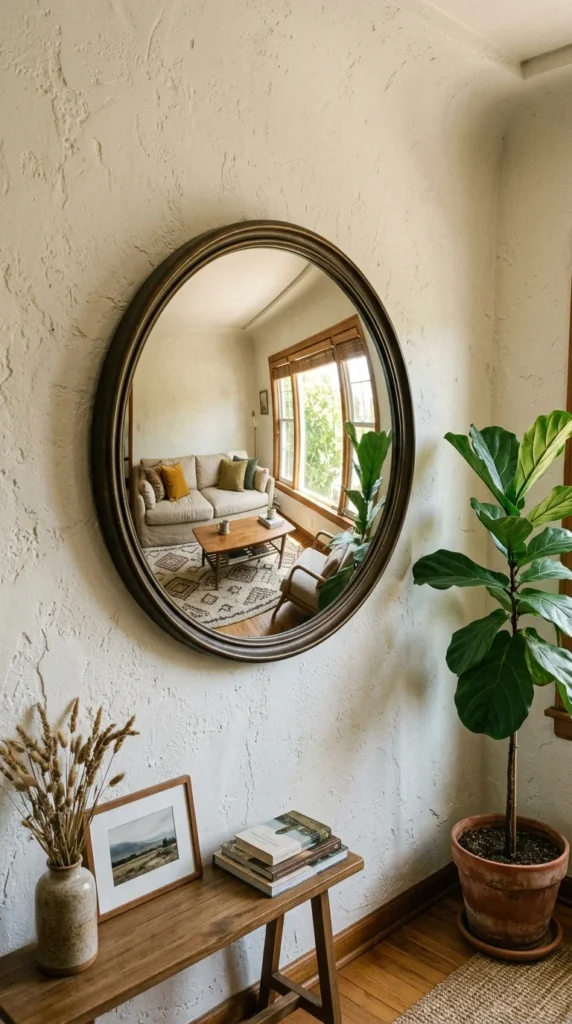
Convex mirrors are the secret weapon of interior designers — and they’ve been used in small spaces for centuries.
The curved surface reflects a wider field of view than a flat mirror. This panoramic reflection makes the room look bigger from inside the mirror’s perspective, and creates an interesting visual focal point on the wall.
They work anywhere but shine in small, dark corners where a flat mirror wouldn’t capture much light or depth.
Hang one in a narrow hallway, above a console table, or in a compact dining room. The fish-eye effect adds dimension to even the plainest wall.
Vintage convex mirrors — sometimes called butler’s mirrors — show up regularly in antique shops and on eBay for $20 to $80.
Budget tip: New convex mirrors are widely available on Amazon for under $50. The dark bronze and black frames look particularly striking against light-colored walls.
The retro aesthetic is also genuinely interesting — it’s one of those pieces that prompts conversation.
Unlike decorative-only wall art, this one actually makes your room function better while looking great.
9. Mirror Behind Open Shelving
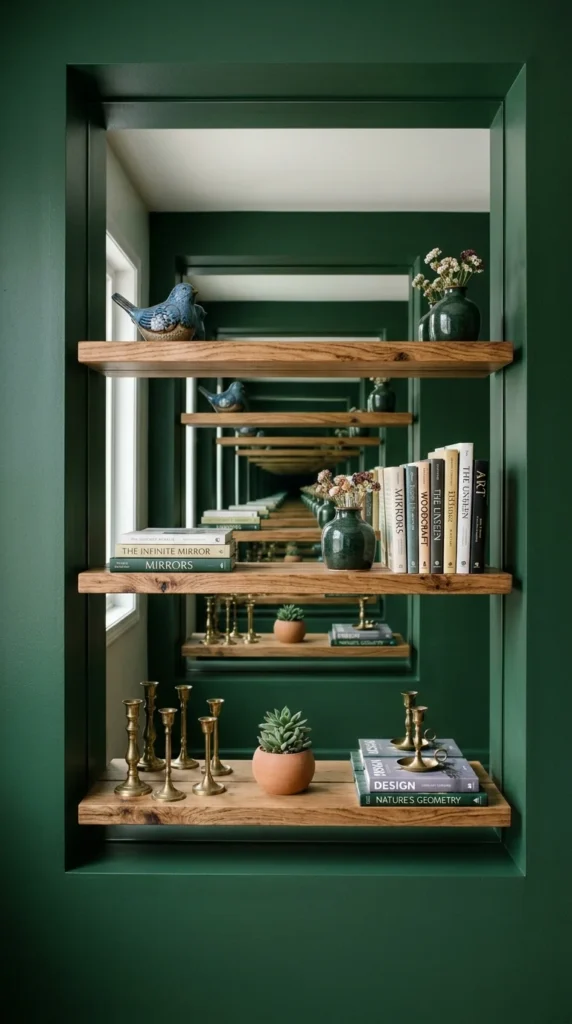
This is a designer trick that’s almost too good for how simple it is.
Mount a large mirror on the wall first. Then install floating shelves directly in front of it.
The mirror creates the illusion that the shelves extend backward into the wall — a kind of infinite depth that makes the space feel dramatically larger.
This works especially well in living rooms, home offices, and kitchens where open shelving is already common.
The objects on the shelves get doubled in the reflection, which adds richness to the display without needing more stuff.
Budget tip: A large frameless mirror from IKEA (the HOVET is perfect for this) costs around $130. Add a few LACK or BERGSHULT shelves mounted over it for a full installation under $200.
Style the shelves with a mix of plants, ceramics, and books. The mirror behind will make even a simple arrangement look carefully curated.
This is one of the most space-efficient uses of wall mirrors available. You get storage, display space, and the appearance of a much larger room — all from one wall.
10. Mirrored Tray on a Console or Dresser
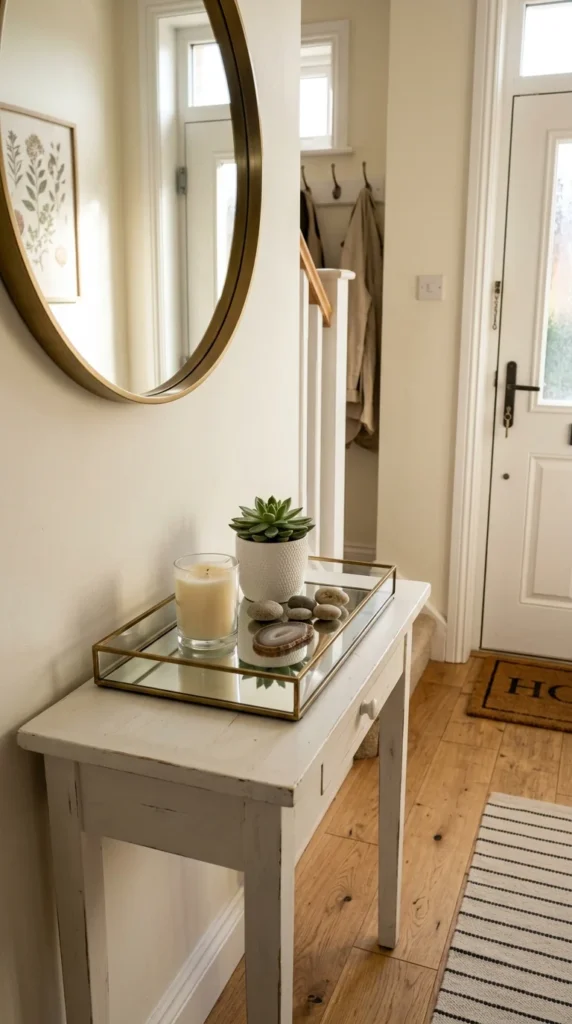
Not every mirror has to hang on the wall.
A mirrored tray on a flat surface — a console, dresser, nightstand, or coffee table — adds the same light-reflecting quality at a fraction of the cost and effort.
Place it beneath a lamp or near a window so the tray catches and bounces the light across the room.
Style the tray with candles, small plants, or a few decorative objects. The mirrored base makes even simple arrangements look polished and deliberate.
This is a great option for renters who can’t hang anything. It also works in addition to wall mirrors to layer the light-reflecting effect.
Budget tip: Mirrored trays are available at HomeGoods, TJ Maxx, and Amazon for $15 to $40. You can also DIY one by cutting a piece of mirror to size (many glass shops will do this for you cheaply) and gluing it to a wooden tray base.
The impact is subtle but cumulative. In a room with multiple light-reflecting surfaces, the combined effect makes the space feel consistently brighter and more open.
11. Arched Mirror Pair Flanking a Focal Point
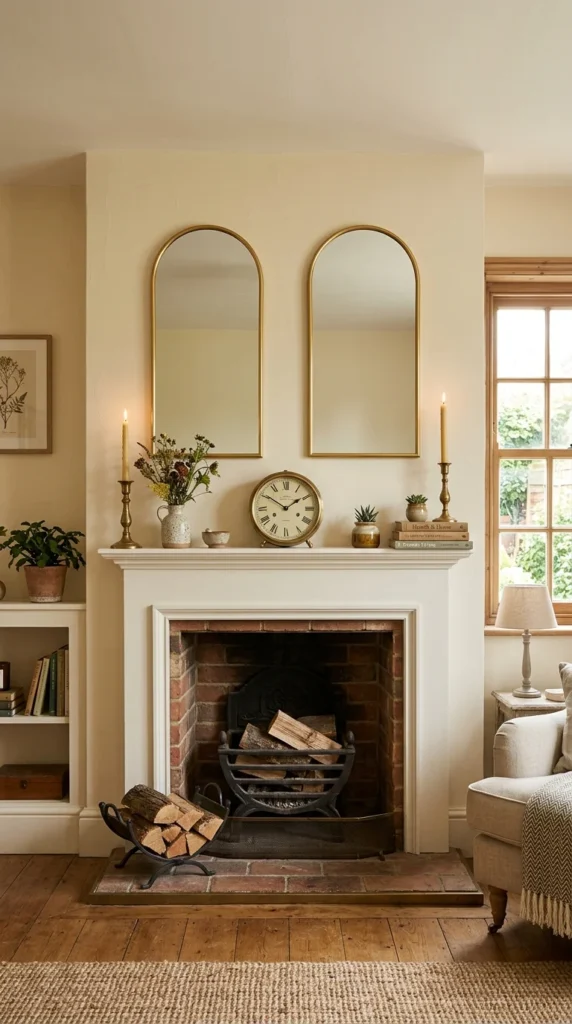
Symmetry is one of the oldest tricks in interior design — and mirrors make it effortless.
Hanging two identical mirrors on either side of a fireplace, bed, or console creates instant visual balance. The matched pair also doubles the reflective surface, spreading light across more of the room.
Choose mirrors that are proportional to whatever sits between them. Too small and they disappear. Too large and they overwhelm.
For a fireplace or console, slim arched or rectangular mirrors work beautifully. They frame the center piece without competing with it.
Budget tip: Buying a matching pair doesn’t mean spending double. Amazon and IKEA carry paired sets for under $80. You can also buy two of the same mirror separately — even budget options look intentional when matched.
Angle each mirror very slightly inward — just a few degrees — so they reflect each other and the center of the room simultaneously.
The effect is layered and architectural. Even in a small room, this arrangement makes the wall feel like it was designed rather than decorated.
12. Bathroom Mirror Extended to the Ceiling
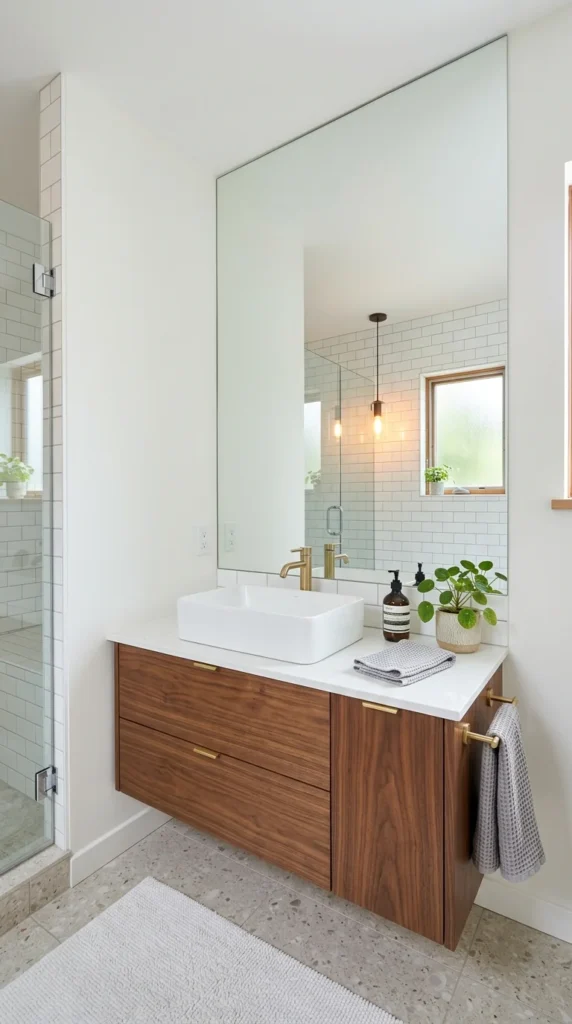
Most bathroom mirrors stop a foot or two below the ceiling. That gap is wasted potential.
Extending your bathroom mirror to the ceiling — or replacing your current mirror with a taller one — adds vertical space to one of the smallest rooms in the home.
A ceiling-height mirror in a bathroom makes the room feel more like a boutique hotel bathroom than a tight residential one.
You don’t need a custom mirror for this. A large frameless rectangle, properly sized, achieves the same result at a fraction of the cost.
Budget tip: A large frameless bathroom mirror from Amazon or Home Depot runs $60 to $150 depending on size. Most can be mounted with mirror clips — no adhesive required.
Pair the taller mirror with a pendant light or a wall-mounted sconce that hangs at eye level. This separates the lighting from the mirror and makes both feel more intentional.
In a bathroom, every inch of perceived space matters. Going taller with your mirror is one of the easiest upgrades you can make — and the difference is immediately visible.
13. Vintage Ornate Mirror in a Modern Room
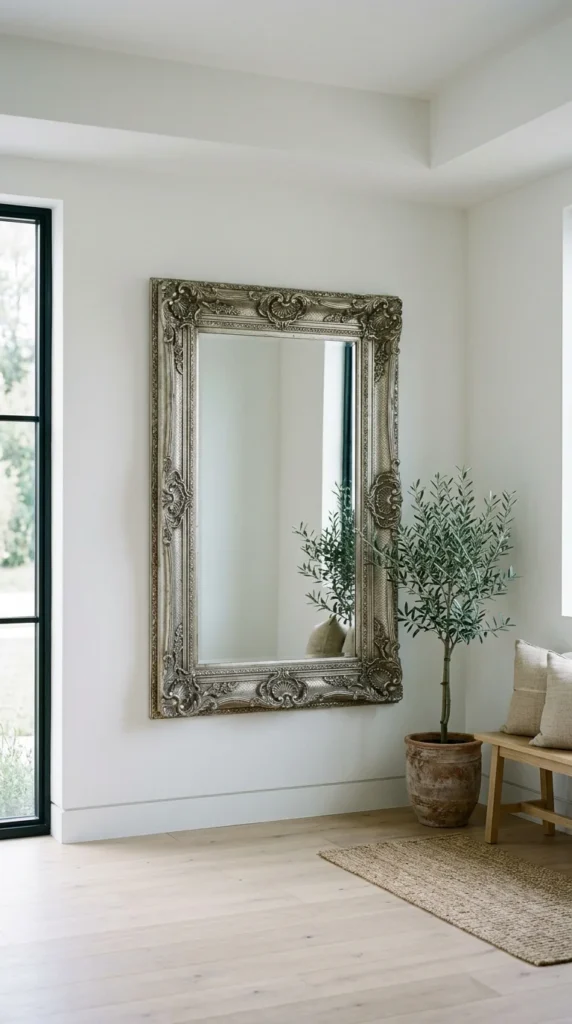
An ornate vintage mirror on a minimal modern wall does something unexpected — it makes both things look better.
The contrast between an elaborate frame and a clean, simple room creates visual interest that neither could achieve alone. The mirror becomes a sculptural focal point. The room becomes a backdrop that lets it shine.
This works especially well in small rooms where a single statement piece does more than a wall full of art.
Look for ornate mirrors at estate sales, antique markets, Chairish, or Facebook Marketplace. Frames with heavy carved wood or plaster detailing — even if the finish is worn — look genuinely beautiful on a white or neutral wall.
Budget tip: Thrift stores and flea markets regularly stock ornate mirrors for $10 to $40. A quick coat of gold or silver spray paint on the frame is all it takes to revive them.
Don’t be afraid of size. A large ornate mirror in a small room feels confident, not crowded.
The reflection adds depth. The frame adds history. Together they make the room feel lived-in and considered.
14. Horizontal Mirror in a Low-Ceiling Room
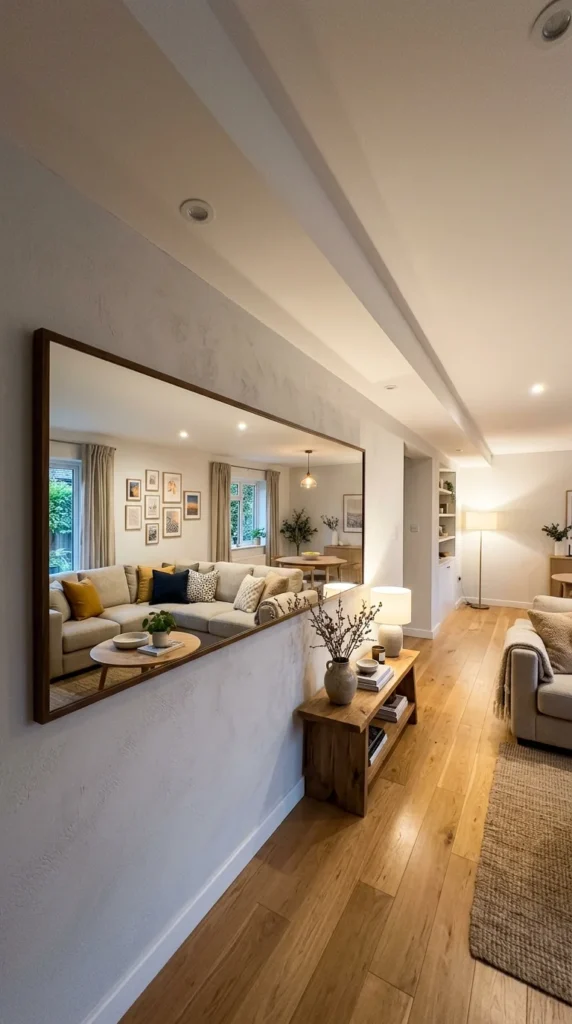
Low ceilings compress a room. But mirrors can fix that — if you choose the right orientation.
A wide horizontal mirror mounted across a wall draws the eye sideways rather than up. This makes the room feel longer and broader, which compensates for the lack of vertical height.
The mirror should span at least half the wall width to read as an intentional design element rather than random wall decor.
Mount it at eye level — about 57 to 60 inches from the floor to the center. This keeps the reflection focused on the room itself, not the ceiling or floor.
Budget tip: Long horizontal mirrors are sold at most furniture stores and online. IKEA’s NISSEDAL in landscape orientation works perfectly. At around $70, it’s a high-impact, low-cost solution.
For a more custom look, hang two or three identical rectangular mirrors side by side in a row, with minimal gap between them.
In rooms where raising the ceiling isn’t possible, this horizontal approach is the most effective workaround. It shifts the viewer’s perception without touching a single structural element.
15. Mirror Inside a Built-In Bookcase
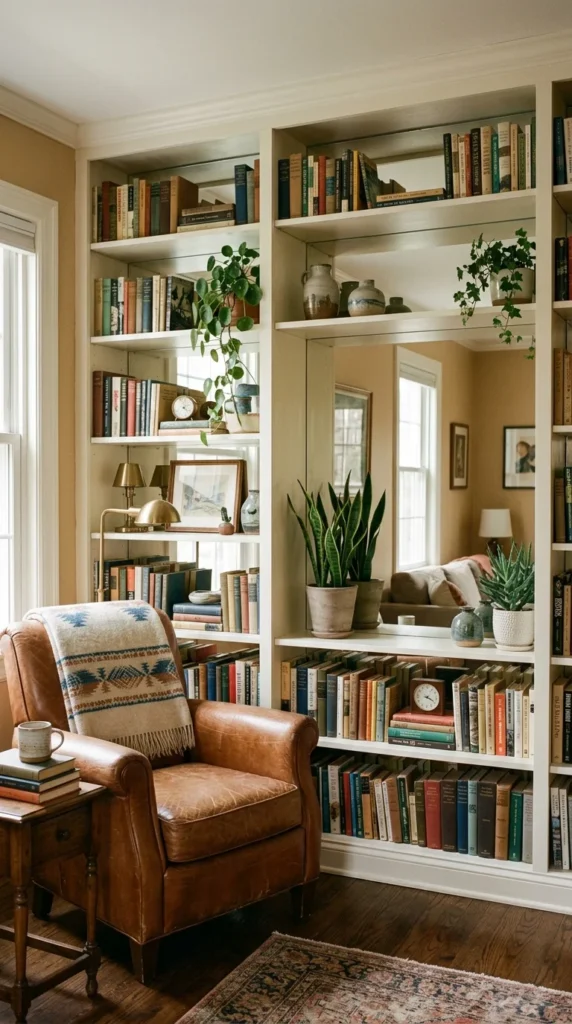
If you have a built-in bookcase or a freestanding bookshelf, the back panel is prime real estate.
Replace the painted or wood-panel back with a mirror — custom-cut to fit — and the entire shelf takes on a new quality. Objects on the shelves appear to float in front of infinite depth.
This is one of the most space-efficient mirror applications because it adds depth without using any additional wall space.
The reflection creates layers: you see the objects on the shelf, then the mirror behind them, then the reflected room behind you. That layering is what makes a small room feel rich rather than cramped.
Budget tip: A local glass shop will cut a mirror to exact dimensions for $20 to $60 depending on size. Some IKEA shelving units (like the KALLAX) accept custom back panels that you can replace yourself.
Mount the mirror with construction adhesive or have it installed in a wood frame that slides into the existing shelf backing.
Style the shelves with a mix of textures — books, plants, ceramics — to take full advantage of the doubled display.
16. Mirror at the End of a Narrow Hallway
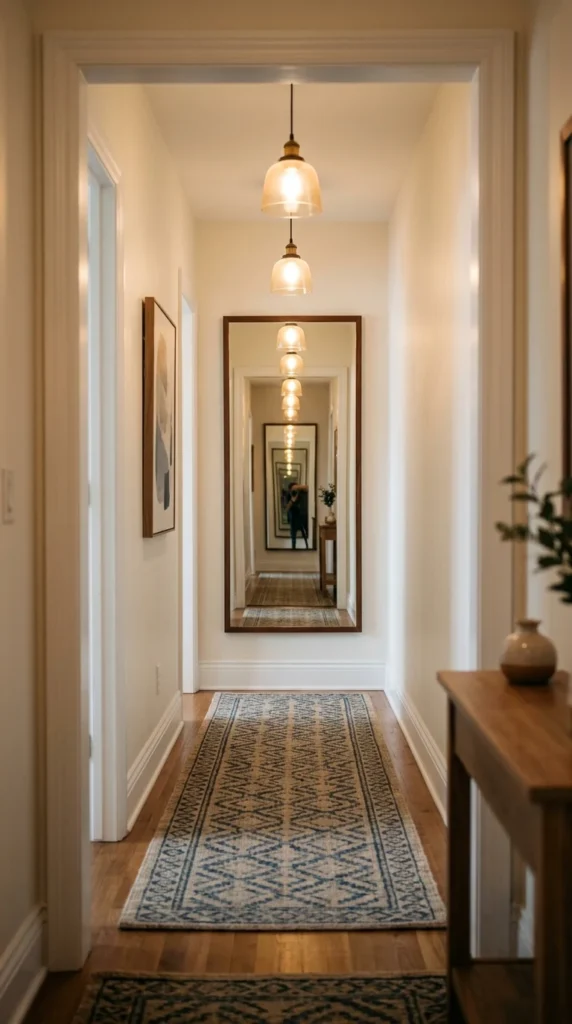
A narrow hallway is one of the most uncomfortable spaces in any home. It feels tight, dark, and utilitarian.
A large mirror placed flat at the far end wall solves this completely.
The mirror reflects the full length of the hallway back at you. From the entrance, the hallway appears to continue on the other side of the mirror — effectively doubling its perceived length.
This is a genuinely disorienting effect in the best way. First-time visitors often do a double-take.
Use a mirror that fills as much of the end wall as possible. Frameless options work particularly well here because they maximize the reflective surface.
Budget tip: A full-length flat mirror in a basic frame costs $30 to $80 at most retailers. Mounted flush to the end wall, it requires no special installation beyond standard mirror anchors.
Add a small console table or floating shelf beneath it with a lamp. The lamp reflection increases the light in the hallway dramatically.
This single change can make a hallway go from feeling like a chore to feeling like a deliberate, welcoming entry into your home.
17. Geometric Mirror Cluster
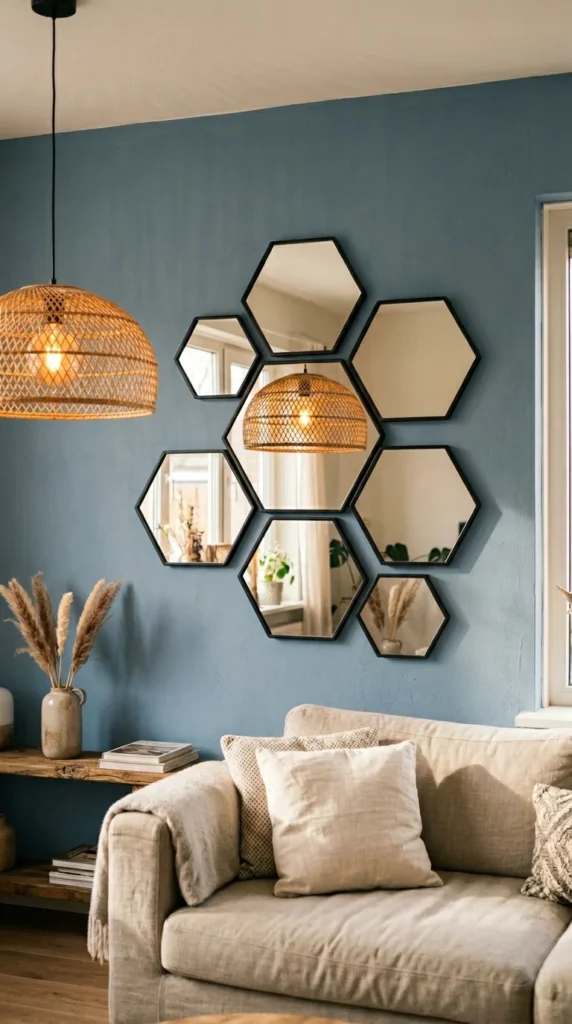
Geometric mirrors arranged in a cluster create a wall installation that’s part art, part function.
Hexagonal mirrors are the most popular — their flat edges make tight clustering possible without gaps. But triangular and diamond shapes work equally well.
The cluster reads as one large cohesive piece from a distance, while up close each individual mirror adds its own small reflective surface.
This is a great way to cover a large wall without a single oversized piece — and without a big budget.
Arrange the cluster on the floor first. Photograph the layout. Then transfer it to the wall, starting from the center and working outward.
Budget tip: Sets of hexagonal mirrors are available on Amazon for $25 to $50 for a set of 6 to 9 pieces. At that price, you can buy two sets and build a larger installation.
Vary the sizing slightly — one or two larger hexagons surrounded by smaller ones — to create a more dynamic composition.
In a small living room or bedroom, a geometric cluster adds visual complexity without visual weight. The wall feels full without feeling heavy.
18. Mirror Positioned to Reflect a Window
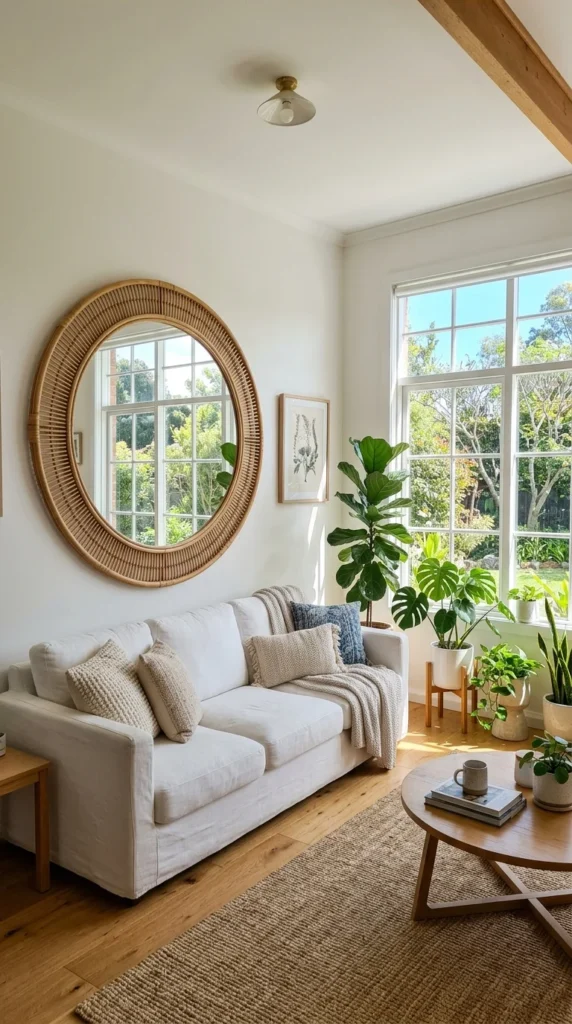
This is the single most effective way to use a mirror in a dark or windowless space.
Place a mirror directly across from a window — or at a 45-degree angle to it — so the glass captures the natural light coming in and throws it back into the room.
The reflection of a window in a mirror looks like a second window. The brain reads it that way. The room instantly feels brighter and more open.
This works best with a large round or rectangular mirror positioned at the same height as the window it’s reflecting.
For rooms with only one small window, this trick can make the light feel almost twice as abundant.
Budget tip: Any mirror works here — the positioning is what matters, not the price. A $30 frameless mirror from IKEA placed correctly outperforms an expensive mirror in the wrong spot.
Hang it between 18 and 24 inches from the window for the strongest reflection effect.
This one placement adjustment can change how a room feels every single day, from morning light to golden afternoon. No renovation. No additional lighting. Just a mirror and a little spatial awareness.
Conclusion
Mirrors are one of the most affordable, renter-friendly, and immediately impactful tools in home design. They don’t require structural changes, expensive materials, or professional installation. What they require is intention — knowing where to place them, how large to go, and what they’ll reflect. The ideas in this list cover every room, every budget, and every level of DIY comfort. Start with one. Lean a large mirror against a bare wall. Hang a round mirror across from your window. Mount a pair of arched mirrors beside your fireplace. Each small change builds on the last, and the cumulative result is a home that feels genuinely bigger, brighter, and more thoughtfully put together. The wall space is already there. All it needs is a mirror.