17 Stunning Boho Living Room Designs That Feel Instantly Cozy
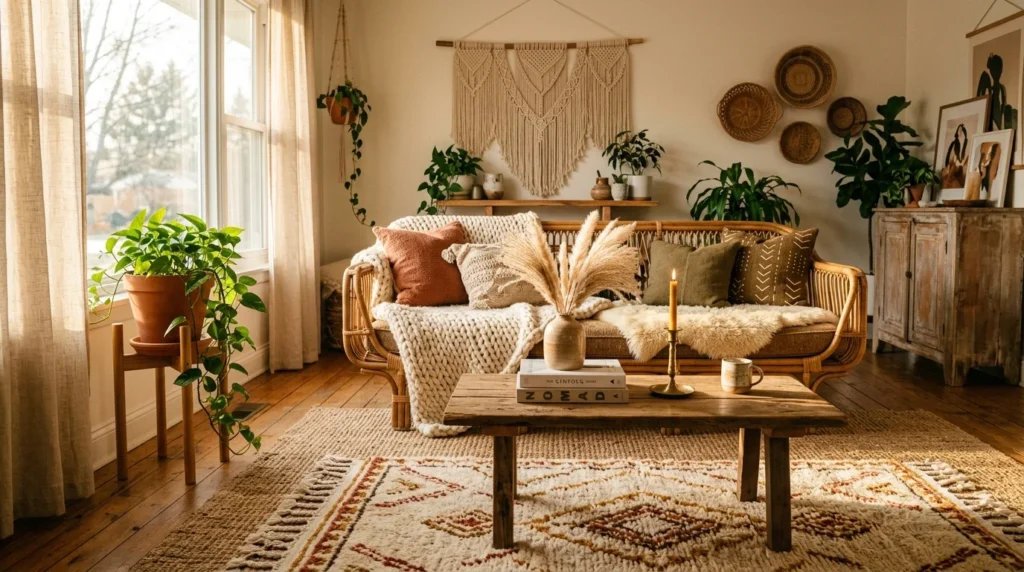
Boho living rooms feel like a hug the moment you walk in. That’s not an accident — it’s the result of specific choices: layered textures, warm tones, natural materials, and a deliberate mix of old and new. The bohemian style has no rigid rules, which is exactly why it works so well for real homes with real budgets. You don’t need to buy everything at once or follow a strict palette. Boho design rewards patience, thrift shopping, and personal taste. Whether you’re starting from scratch or refreshing a tired space, these 17 ideas give you a clear, practical path to a living room that feels warm, grounded, and completely yours.
1. Layer Multiple Rugs for Warmth and Depth
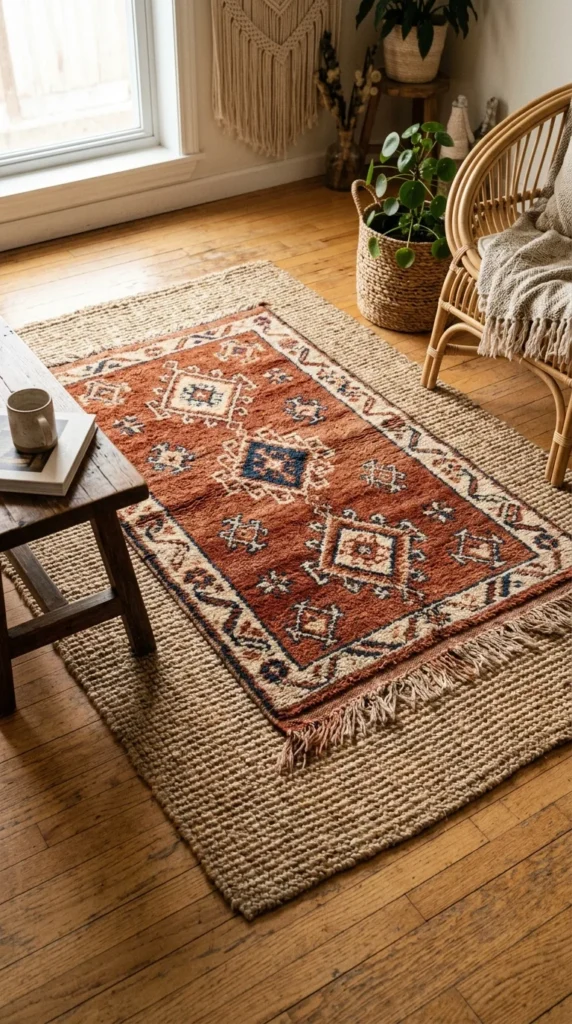
Layering rugs is one of the simplest ways to make a boho living room feel rich and lived-in.
Start with a large, flat-weave jute or sisal rug as your base. These are affordable — often $60–120 for an 8×10 — and add natural texture without competing with everything else.
On top, place a smaller patterned rug. A vintage Moroccan-style rug in rust, cream, or terracotta works beautifully. These are available on OverStock, Ruggable, and Etsy for $50–150.
The layered look works best when:
- The bottom rug is larger and neutral
- The top rug is smaller, patterned, and centered
- The two rugs share at least one color
Budget tip: Check Facebook Marketplace for secondhand rugs. Vintage wool rugs from the 1970s and 80s fit the boho palette perfectly and cost a fraction of new.
Don’t worry about matching perfectly. Slight color tension between the two rugs is actually part of what makes the look feel collected rather than catalog-styled.
2. Build a Low-Slung Seating Area
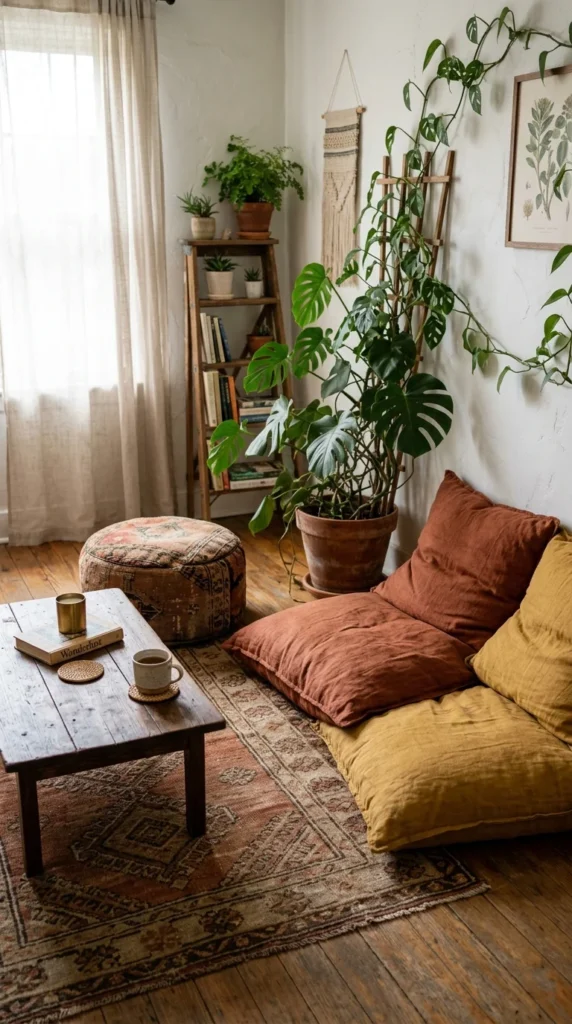
Low seating is one of the defining features of bohemian interiors — and it immediately makes a room feel more relaxed.
Floor cushions, poufs, low sofas, and platform seating all contribute to that grounded, informal quality that boho spaces are known for.
Easy ways to go low:
- Replace a standard sofa with a low-profile platform couch
- Add oversized floor cushions around a low coffee table
- Use a Moroccan leather pouf as both seating and a footrest
- Layer a mattress or futon on a low wooden pallet frame for a reading nook corner
Floor cushions are among the most affordable boho purchases. IKEA, Amazon, and TJ Maxx all carry large floor pillows in earthy tones for $20–40 each.
A kilim-style pouf runs $30–60 on Amazon or World Market and doubles as a side table with a tray on top.
DIY option: Sew a large floor cushion from a printed cotton fabric. The cover for a 26-inch square cushion takes less than 2 yards of fabric and an hour to sew, even for beginners.
3. Hang Macramé Above the Sofa
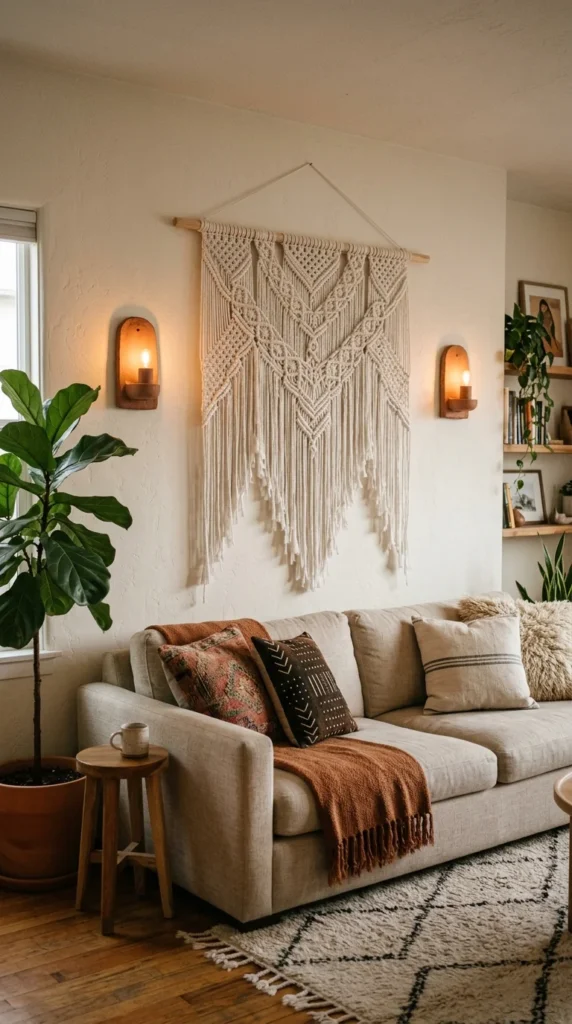
A macramé wall hanging above the sofa acts as both art and texture — two things a boho room always benefits from.
The knotted quality of macramé adds dimension that flat prints simply can’t. From across the room, it reads as sculpture. Up close, the detail of the knots and fringe becomes its own visual story.
Sizing tip: The hanging should be roughly two-thirds the width of your sofa. For a standard 84-inch sofa, aim for a hanging that’s 50–60 inches wide. This proportion looks balanced and intentional.
Where to find one:
- Etsy handmade macramé: $40–120 depending on size
- TJ Maxx and HomeGoods: rotating stock, often $30–60
- World Market: reliable boho options year-round
DIY option: A basic large macramé piece uses only the square knot and spiral knot. Buy 3mm natural cotton rope ($15–20 for a large spool) and a wooden dowel ($3). Free beginner tutorials on YouTube walk through the whole process in under two hours.
Hang it with two small cup hooks. The weight is minimal and most adhesive hooks handle it fine for renters.
4. Fill Corners With Statement Plants
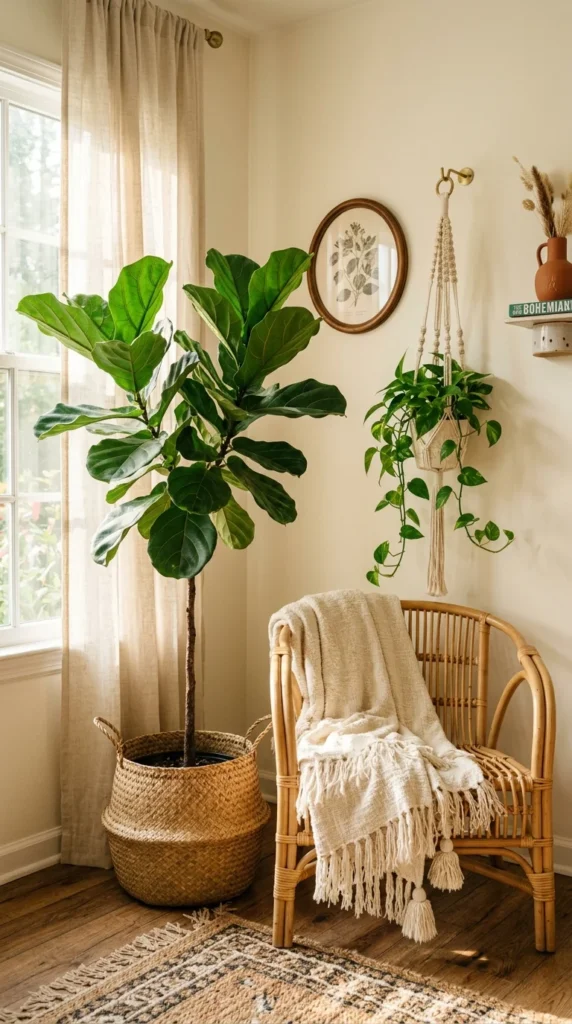
Plants are non-negotiable in a boho living room. They bring life, color, and organic irregularity that no decor object can replicate.
The key is going big and varied. One large statement plant in a corner does more work than five small plants scattered around. A fiddle leaf fig, monstera, or bird of paradise creates immediate visual impact and fills vertical space that would otherwise feel empty.
Best boho plant pairings:
- Large fiddle leaf fig or monstera in a woven seagrass basket
- Trailing pothos in a macramé hanger near a window
- A cluster of cacti and succulents on a low shelf or windowsill
- Snake plant in a terracotta pot for a low-maintenance option
Cost-saving strategy: Buy young plants and grow them. A small monstera from a garden center costs $10–20. With good light and patience, it becomes a statement plant within a year.
Baskets as planters add texture and warmth. IKEA, Target, and TJ Maxx carry seagrass and rattan baskets in sizes that fit standard nursery pots for $8–25.
5. Mix Warm Earthy Tones Across Textiles
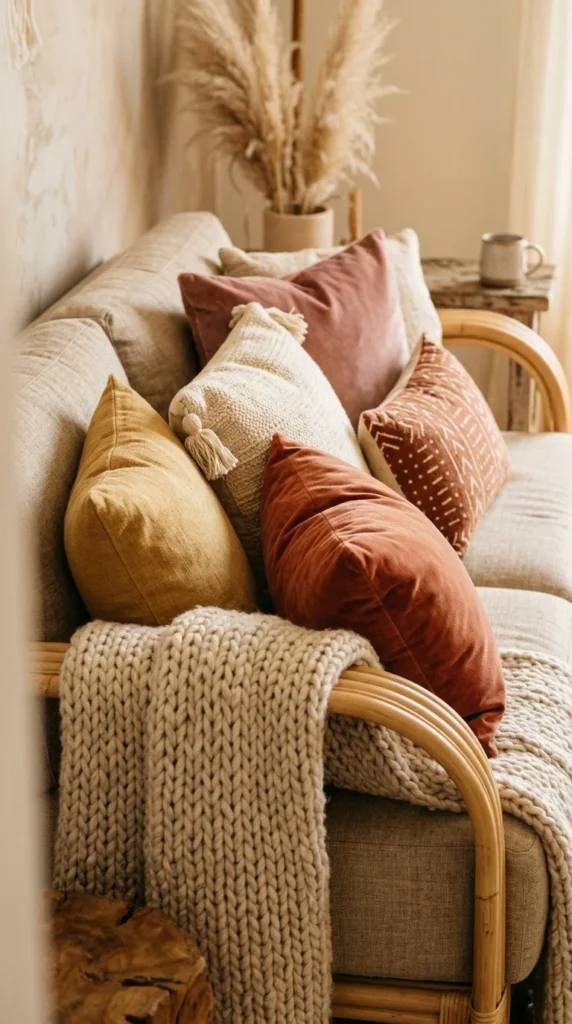
Color sets the mood in a boho room faster than anything else — and the boho palette is specific.
Think warm, muted, earthy: terracotta, rust, mustard, sage green, warm cream, dusty rose, ochre, and chocolate brown. These tones feel grounded and warm without being loud.
The easiest way to build this palette is through textiles — pillows, throws, and curtains. These are also the most affordable and changeable elements in any room.
Pillow strategy: Buy a base set of 4–6 pillow covers in two or three coordinating earthy tones. Mix textures: one linen, one woven cotton, one with fringe or tassels. Pillow covers (without inserts) run $8–20 each on Amazon and Etsy.
Throw blankets: A chunky knit throw in cream or terracotta draped over a sofa arm is one of the most photographed boho details. These run $25–50 at TJ Maxx, H&M Home, and Amazon.
The rule to follow: No more than four main colors in the palette. Let them vary in saturation — some deep, some faded — for that layered, collected quality.
6. Bring In Rattan and Wicker Furniture
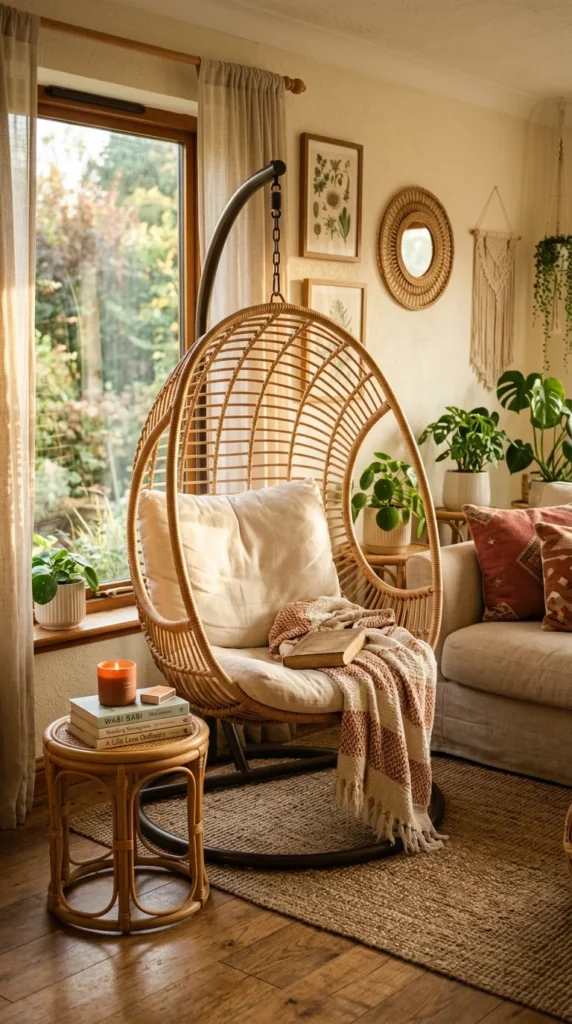
Rattan and wicker furniture are the backbone of the boho aesthetic.
They bring warmth, texture, and a natural quality that upholstered furniture alone can’t deliver. Even one rattan piece — a chair, a side table, a pendant light — immediately shifts the room’s feel.
Best boho rattan pieces for living rooms:
- Rattan egg chair or hanging chair (statement seating)
- Wicker side table or tray table
- Rattan floor lamp or pendant shade
- Rattan bookshelf or media unit
Budget approach: Target’s Opalhouse and Threshold lines carry affordable rattan furniture. World Market is another reliable source. Facebook Marketplace frequently has rattan pieces for $20–60 — the natural finish of rattan hides wear beautifully.
Refreshing old rattan: If you find a piece that looks dry or faded, wipe it down with a damp cloth and apply a coat of teak oil or Danish oil. It restores the warm honey tone instantly.
Pair rattan with soft textiles — a linen cushion, a woven throw — to balance the hardness of the material and keep the space feeling soft and cozy rather than beachy or rustic.
7. Use Curtains That Puddle or Pool on the Floor
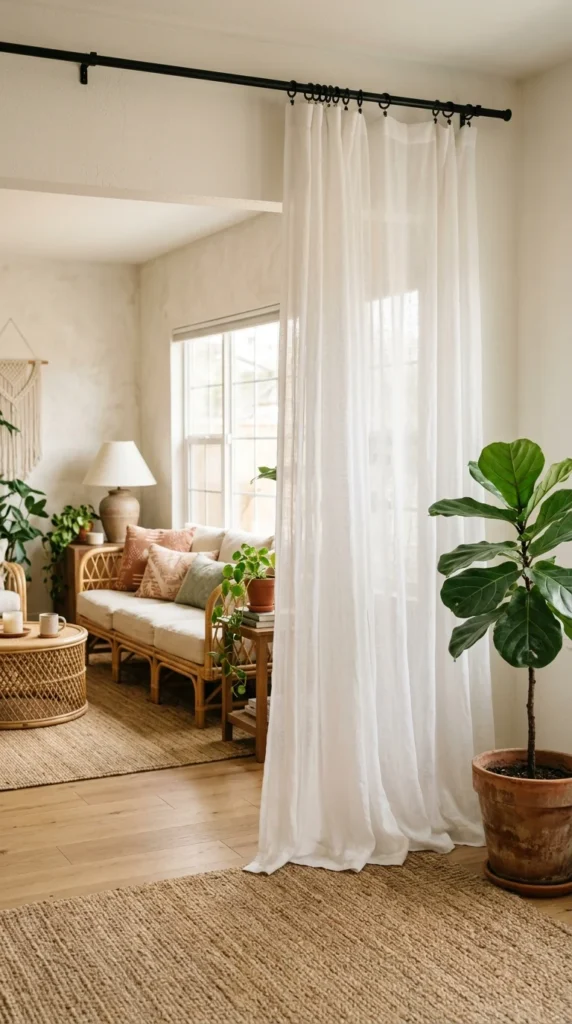
Curtains that are too short look like an afterthought. Curtains that just graze the floor look intentional. Curtains that pool slightly? That’s a boho signature.
A small puddle of fabric on the floor (about 1–2 inches) creates a relaxed, romantic quality that instantly softens a room.
Fabric choices for boho:
- Sheer white or cream linen (airy, light-filtering)
- Washed cotton in a muted earthy tone
- Printed cotton with a subtle pattern
IKEA’s HANNALILL and LISELOTTE sheers are consistently popular boho choices under $30 per panel. For heavier linen-look curtains, H&M Home and Amazon carry options for $25–50 per panel.
The height trick: Hang the rod as close to the ceiling as possible. This makes the ceiling feel taller and the windows feel larger — even if the actual windows are standard height.
Order curtains 6–12 inches longer than standard for the puddle effect. For an 8-foot ceiling, buy 108-inch panels instead of 96-inch.
Rod choice: A simple black iron rod or warm brass rod both work well in boho spaces. These run $15–30 at IKEA or Amazon.
8. Create a Gallery Wall With Mixed Mediums
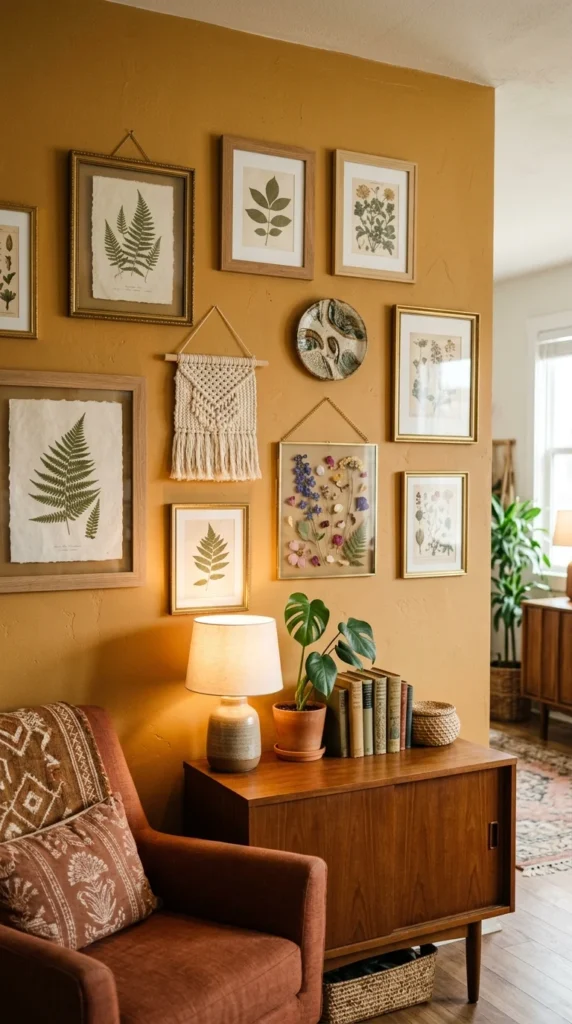
A boho gallery wall isn’t a grid — it’s a collection.
The mix of mediums is what sets it apart from a standard art display. Combine flat art with three-dimensional objects and the wall gains real depth.
What to include:
- Framed botanical or nature prints (free downloads from Biodiversity Heritage Library)
- A small woven textile or mini macramé piece
- A ceramic wall hanging or moon phase disc
- A pressed dried flower arrangement in a small frame
- A vintage mirror or small brass sunburst
- A meaningful photograph in a simple frame
Use the same frame finish — all rattan-edged, all black, or all natural wood — across the flat pieces. The 3D objects can vary freely.
Layout tip: Lay everything on the floor first. Photograph it, then use paper templates to map the arrangement on the wall before hanging.
Budget: Most of this wall can be assembled for under $75. Botanical prints are free to download and cheap to print. Ceramic wall hangings run $15–30 on Etsy. Frames from thrift stores cost $1–5 each.
9. Add a Woven Wall Basket Cluster
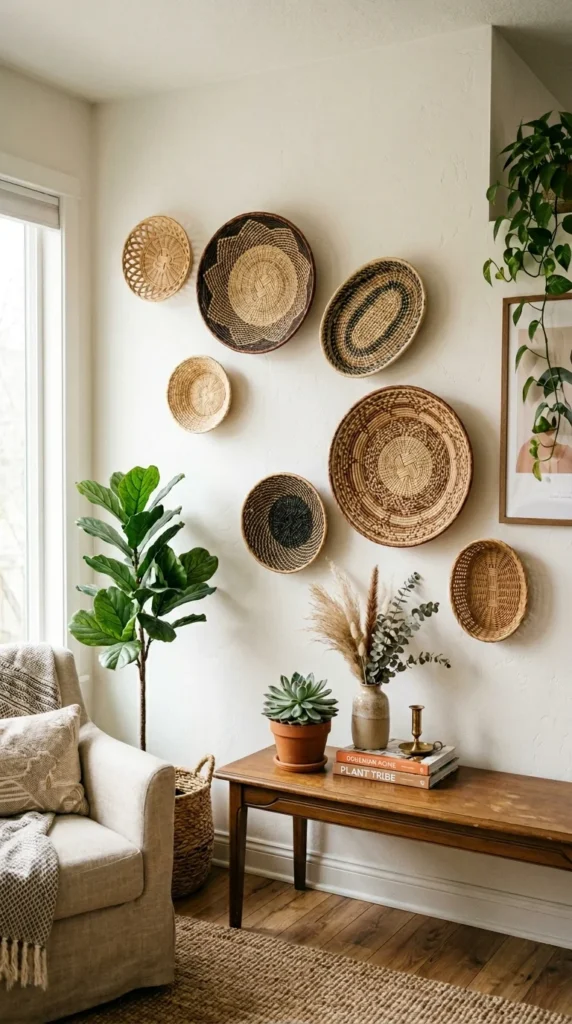
Basket walls are textural, dimensional, and surprisingly affordable to put together.
Unlike flat art, baskets catch light and shadow throughout the day, making the wall look different in morning sun versus evening lamp light. That quality is what makes them feel so alive.
How to build the cluster:
- Start with one large basket (14–18 inches) slightly off-center
- Work outward with medium and small baskets
- Mix round shapes with occasional oval or hexagonal ones
- Vary the weave — tight, open, dark banding, natural — for visual interest
Where to buy:
- TJ Maxx and HomeGoods: $5–20 per basket
- World Market: $10–30 for more decorative options
- Thrift stores: often $1–3 each
- Amazon: sets of 3–5 baskets in coordinating sizes
Most baskets have a loop on the back for hanging. For baskets without loops, a small sawtooth picture hanger glued inside works well.
Number to aim for: 6–10 baskets for a full, statement-level cluster. Fewer than five on a large wall looks sparse.
Start with three or four and add gradually. The collected-over-time quality is part of the boho charm.
10. Style a Low Wooden Coffee Table as a Vignette
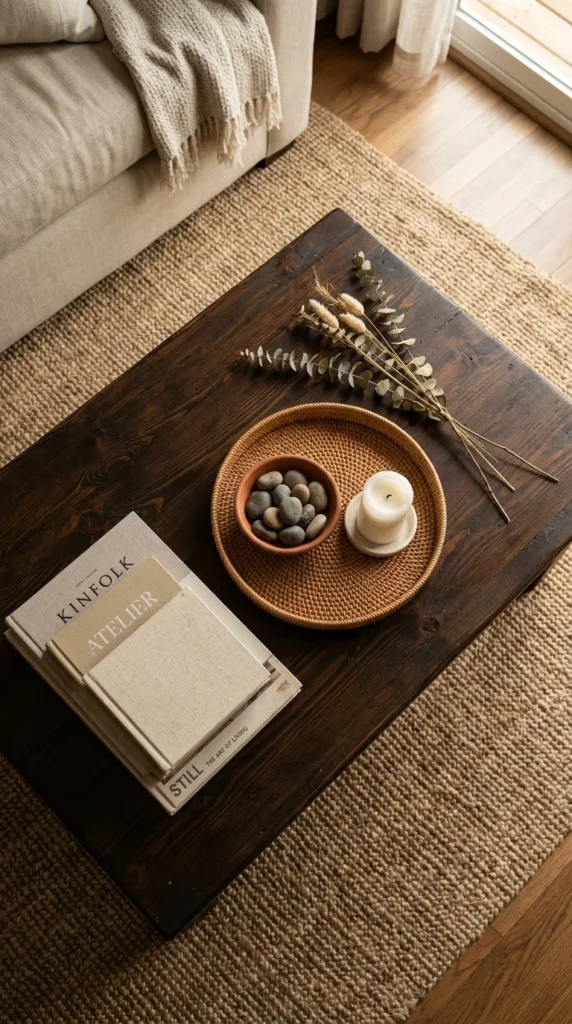
The coffee table is the anchor of a living room — and in a boho space, it should be styled like a curated display rather than left bare or cluttered.
A low, solid wood coffee table in a dark or natural finish suits the boho aesthetic best. Look for hairpin legs, raw edges, or a slab-style top for added character.
The vignette formula:
- One rattan or woven tray to define the center
- A stack of 2–3 coffee table books (turn them face-down for a cleaner look)
- A small candle or candle cluster
- One natural object: a geode, river stones, a driftwood piece, or a small ceramic dish
- A dried flower stem or small plant in a clay pot
Styling rule: Keep one-third of the table surface clear. That negative space makes the styled area look intentional rather than cluttered.
Budget tip: Thrift stores are full of coffee table books for $1–3 each. Choose ones with spines in earthy tones. The candles and trays can come from Dollar Tree or IKEA.
11. Hang String Lights for Ambient Mood Lighting
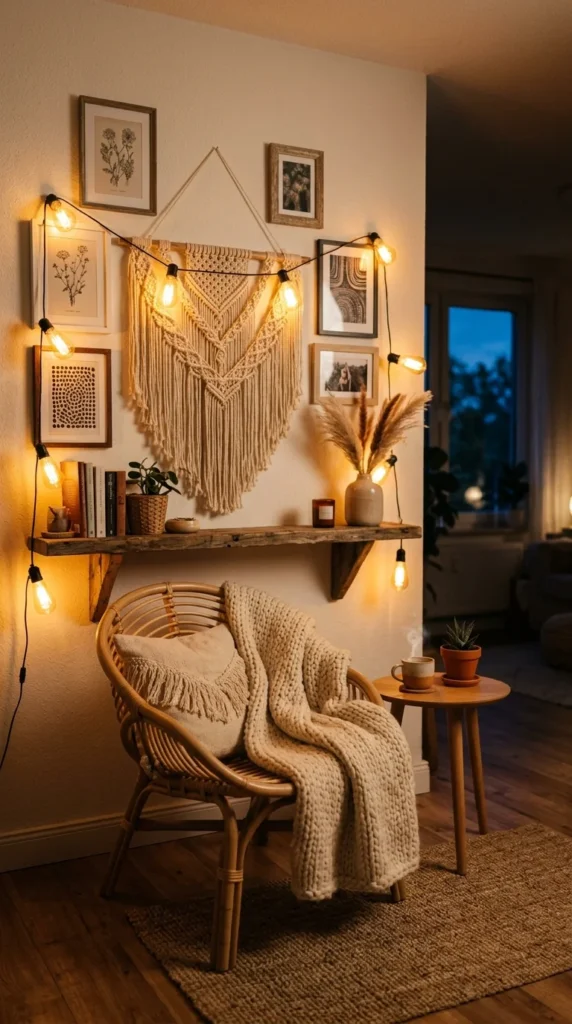
Lighting transforms a room’s mood more than almost any other change — and string lights are the most affordable way to add warmth and atmosphere to a boho living room.
Edison bulb string lights in a warm amber tone (2200K) create the soft, glowing quality that makes boho interiors so immediately inviting. The exposed filament of Edison bulbs also adds a visual element that standard bulbs don’t.
Where to use them:
- Draped along a bookshelf or wooden beam
- Framing a gallery wall
- Woven through a macramé hanging
- Looped around a large mirror
- Hung in a zigzag pattern across a window
Solar or battery-powered string lights need no outlet and give you full flexibility in placement. Plug-in versions with a dimmer switch offer the best ambiance control.
Cost: A 33-foot strand of Edison string lights runs $12–20 on Amazon. Buy two for a fuller effect.
Combine string lights with a warm-toned floor lamp for layered, multi-source lighting. Overhead lighting alone flattens a room. Multiple light sources at different heights is the real secret to that golden boho glow.
12. Use Terracotta Pots and Clay Objects Throughout
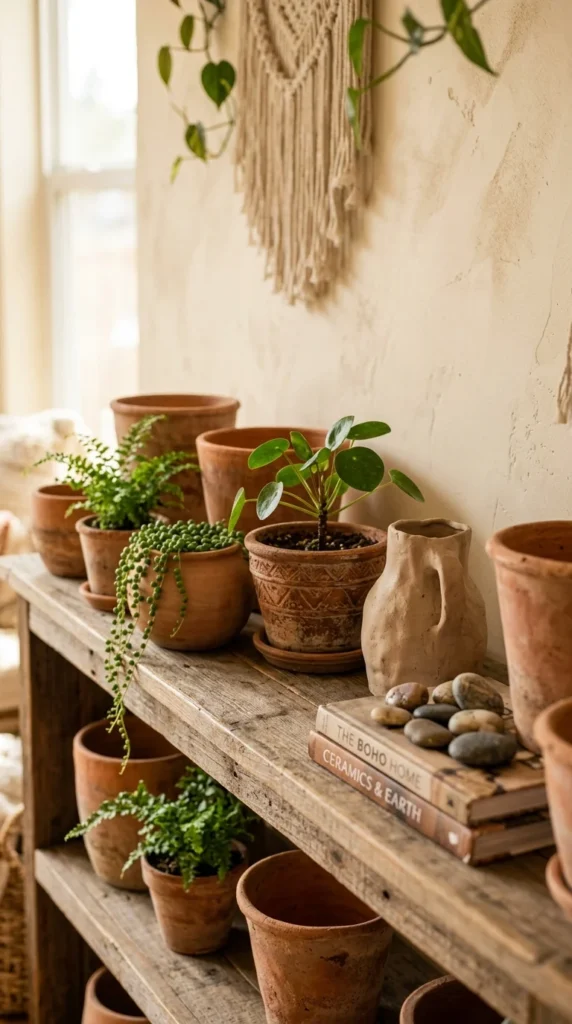
Terracotta is the material of boho design. Its warm, matte, orange-red tone works with almost every other boho element — rattan, macramé, linen, dried botanicals, raw wood.
The beauty of terracotta is its imperfection. Each pot has slight variations in tone and texture that make them look handmade even when they’re not.
Ways to use terracotta throughout a living room:
- Plant pots in multiple sizes on shelves and floors
- A terracotta bowl on the coffee table for keys or small objects
- A clay vase (even empty) on a bookshelf
- A set of terracotta candleholders clustered on a tray
- A terracotta wall disc or decorative plate
Budget: Standard nursery terracotta pots are some of the cheapest objects in any hardware or garden store — $1–8 each depending on size. Dress them up by painting simple patterns with white acrylic paint or sealing them with matte clay wax for a smoother look.
Handmade clay objects from Etsy add character but aren’t always necessary. A $2 terracotta pot from a garden center can look just as good on a styled shelf.
13. Introduce a Canopy or Draped Fabric Over Seating
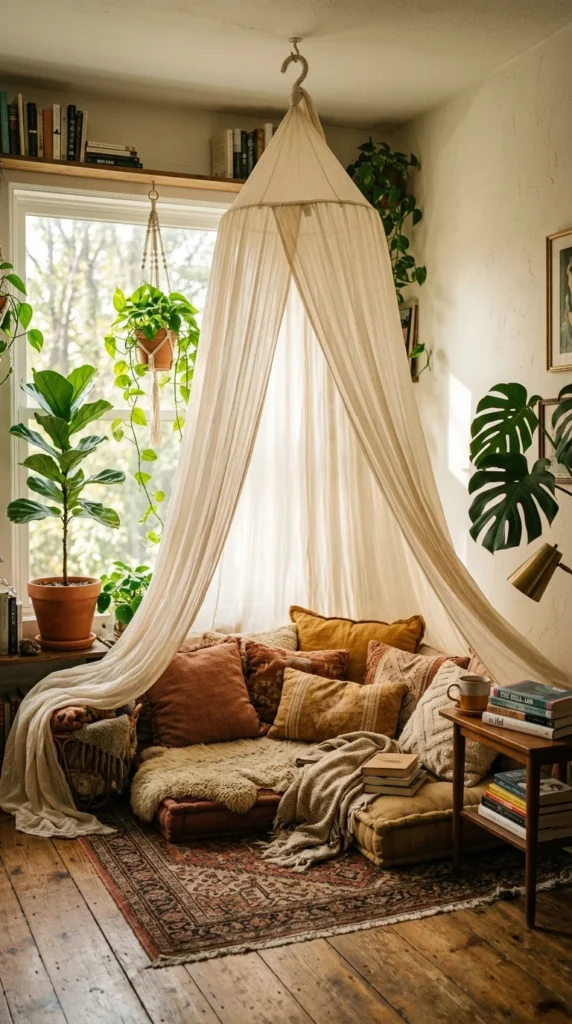
A fabric canopy above a seating area turns a plain corner into a destination — a specific spot that feels intentional, cozy, and slightly separate from the rest of the room.
This is one of the most dramatic-looking ideas that actually costs very little.
How to create a simple canopy:
- Attach a ceiling hook above the seating area
- Hang 2–3 yards of sheer fabric (muslin, voile, or lightweight linen) from the hook
- Let the fabric drape naturally outward and pool slightly on either side
- Secure the outer edges to the wall with small cup hooks if needed
Fabric cost: A 2-yard piece of sheer muslin costs $4–8 at any fabric store. White, cream, or a pale terracotta all work beautifully.
This works best above a floor cushion reading corner, a low platform chair, or a window seat.
Boho styling around it: Add a floor lamp beside the canopy. Place a small stack of books and a candle inside the space. Hang one small plant nearby. The enclosed quality of the canopy is what makes the corner feel like an escape within the room.
14. Display Dried Botanicals and Pampas Grass
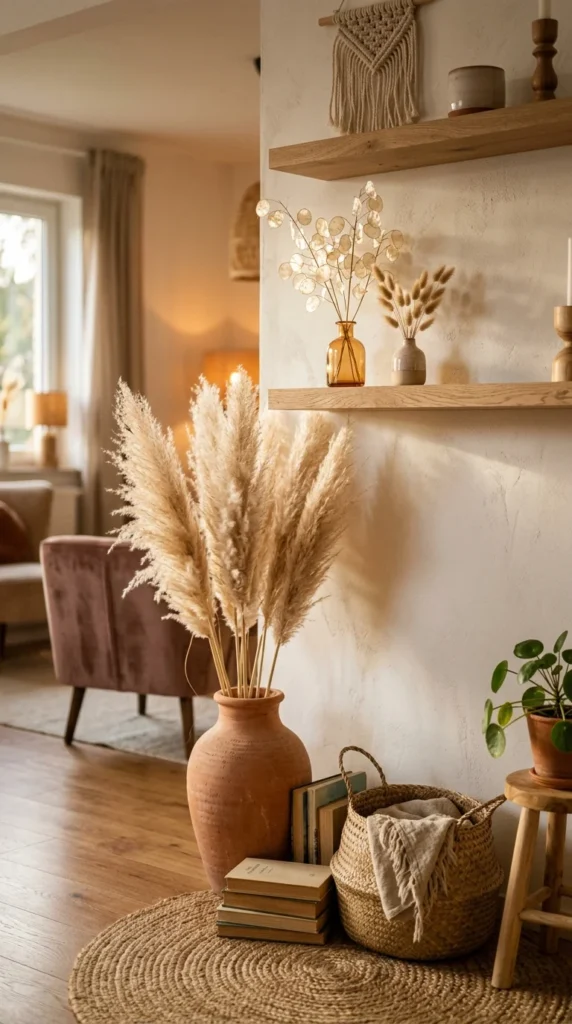
Dried botanicals have replaced fresh flowers as the boho decor element of choice — and for good reason.
They last for months (sometimes years), cost very little, require zero maintenance, and photograph beautifully in the warm light that boho rooms are known for.
Most popular dried botanicals for boho spaces:
- Pampas grass — the most iconic, in white or natural
- Bunny tail grass (Lagurus) — small, soft, clusters beautifully
- Lunaria (money plant) — translucent silvery seed pods
- Dried cotton stems — soft, organic, almost sculptural
- Dried lavender — adds subtle color and scent
- Eucalyptus stems — hold their shape and color well when dried
Where to buy affordably:
- Trader Joe’s and Whole Foods often carry dried stems seasonally
- Etsy sellers offer full bundles for $15–35
- Dry your own by hanging fresh flowers upside down in a warm, dry space for 2–3 weeks
Display tip: Group odd numbers — three stems in a slim vase, five in a wider one. A single large pampas arrangement in a floor vase beside a sofa is an instant boho statement.
15. Paint an Accent Wall in a Deep Earthy Tone
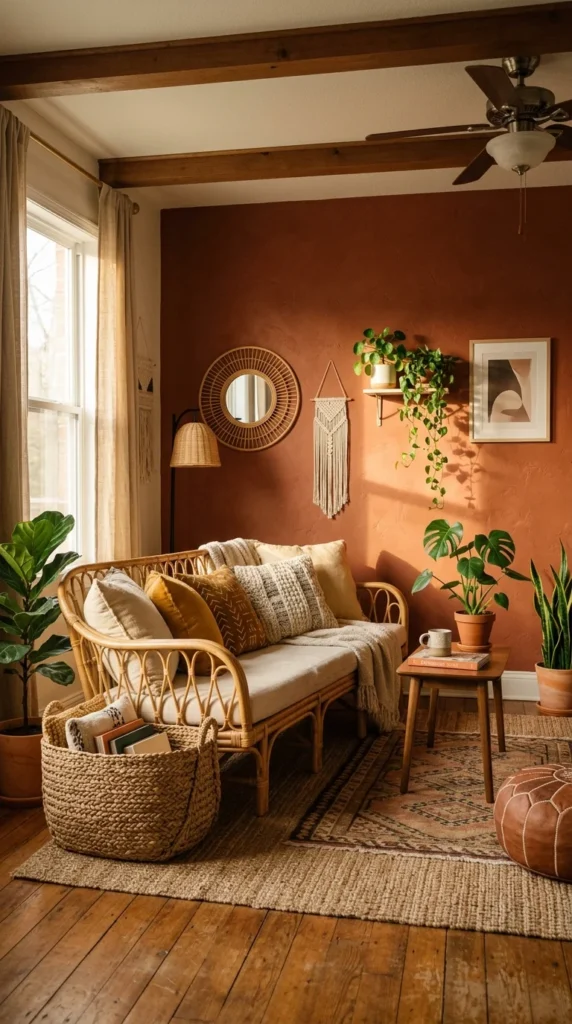
A single painted accent wall changes a room faster than almost any other project — and one quart of paint is usually all you need.
In a boho living room, the right color transforms a flat, forgettable space into something that feels designed and warm.
Best boho accent wall colors:
- Deep terracotta or clay red
- Warm ochre or golden yellow
- Dusty sage green
- Warm chocolate brown
- Muted burnt orange
These tones work because they’re warm, slightly desaturated, and feel like they belong to the natural world rather than a paint chip.
Budget math: A quart of paint covers roughly 100 square feet — more than enough for one standard wall. Quality paint runs $10–18 per quart at most hardware stores.
Paint sampling first: Buy $5 sample pots before committing. Paint large swatches (at least 12×12 inches) and observe them in both natural and artificial light before choosing.
The accent wall works best behind the sofa or behind the main seating area. That placement frames the furniture and creates an instant backdrop that makes everything in front of it look more composed.
16. Stack Books and Decor on Open Shelving
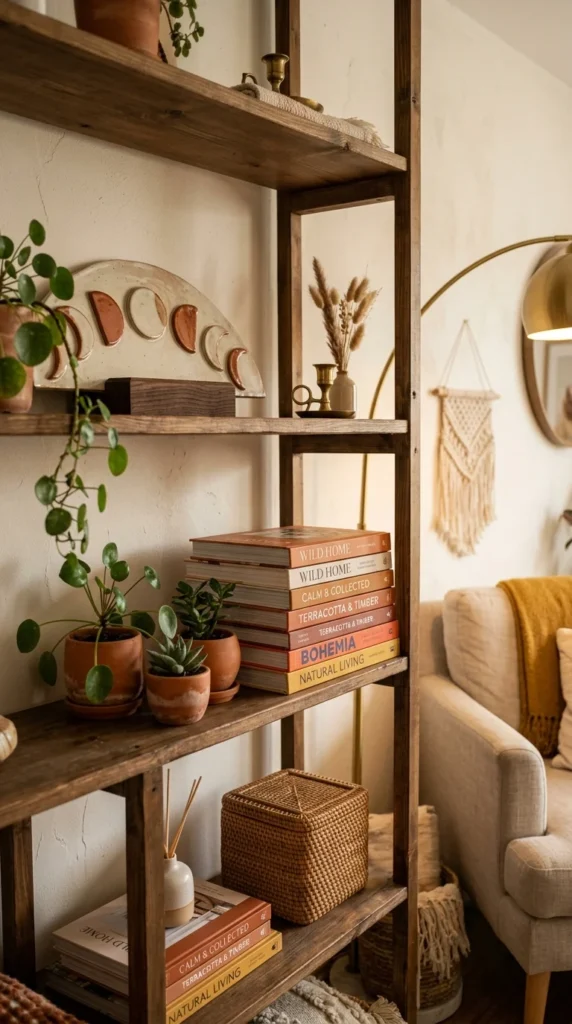
Open shelving in a boho room isn’t storage — it’s a display.
Every object on those shelves contributes to the room’s visual story, so thoughtful curation matters more than quantity.
The boho shelf formula:
Layer books horizontally (spines facing out) rather than standing them vertically. Remove dust jackets — bare hardcovers in neutral tones look far more cohesive. Stack 3–5 books, then place a small object on top.
Objects to intersperse:
- Small terracotta pots (with or without plants)
- A single ceramic piece — a small bowl, a sculptural vase
- A woven or rattan basket as a bookend
- A small framed photo or art print leaning against the wall
- A trailing plant spilling over one edge of the shelf
Leave breathing room. A shelf that’s 60–70% full looks styled. One that’s 90% full looks cluttered.
Affordable shelving options: IKEA’s KALLAX and BILLY systems are boho-friendly and very affordable. Floating wood shelves from a lumber yard give a warmer, more natural look for $15–30 per shelf including brackets.
17. Add a Vintage or Thrifted Statement Piece
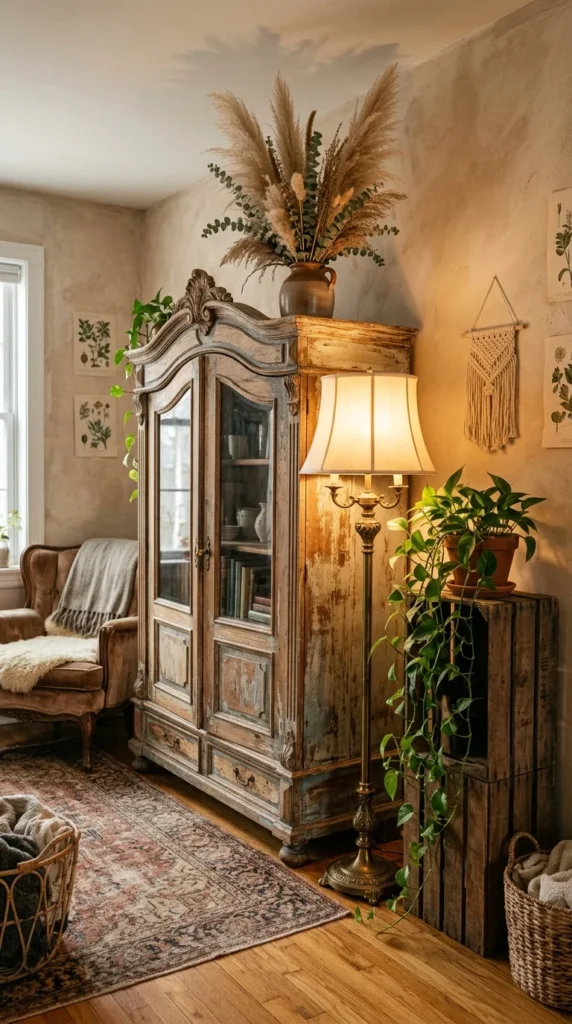
Every boho room benefits from at least one piece with real history.
It doesn’t need to be expensive or rare. A thrifted armoire, a vintage lamp, an antique wooden trunk used as a coffee table — these pieces add a patina and character that new furniture simply can’t fake.
The vintage or antique piece becomes the room’s anchor. Everything around it gets to be simpler because that one object carries so much visual weight on its own.
Where to find boho-friendly vintage pieces:
- Facebook Marketplace and Craigslist (often free or under $50)
- Thrift stores like Goodwill, Salvation Army, and Habitat ReStores
- Estate sales and flea markets (best for furniture and lamps)
- eBay for smaller decorative objects
What to look for:
- Wooden furniture with a warm, worn finish
- Brass or copper lamps with interesting shapes
- Rattan or wicker pieces that need minor repair
- Wooden trunks or chests for storage-as-furniture
Refreshing thrifted furniture: A light sand and a coat of teak oil or beeswax restores most wooden pieces. Replacing hardware with brass pulls immediately updates a dresser or cabinet.
One well-chosen vintage piece does more for a boho living room than a cart full of new accessories.
Conclusion
A boho living room isn’t built in a single shopping trip — and that’s part of its charm. The best versions of this style are assembled gradually: a thrifted basket here, a macramé piece there, a plant that’s grown from a tiny cutting into something magnificent over two years. What ties it all together isn’t a specific product or a particular shade of terracotta. It’s the warmth that comes from making deliberate choices about texture, light, and natural materials. Start with one or two of these ideas that fit your current budget and space. Style a coffee table vignette. Hang a few baskets. Layer a second rug over what you already have. Small changes compound quickly in a boho room — and before long, you’ll have a space that genuinely feels like it was designed for you, because it was.